Talc USP by Behansar Co.
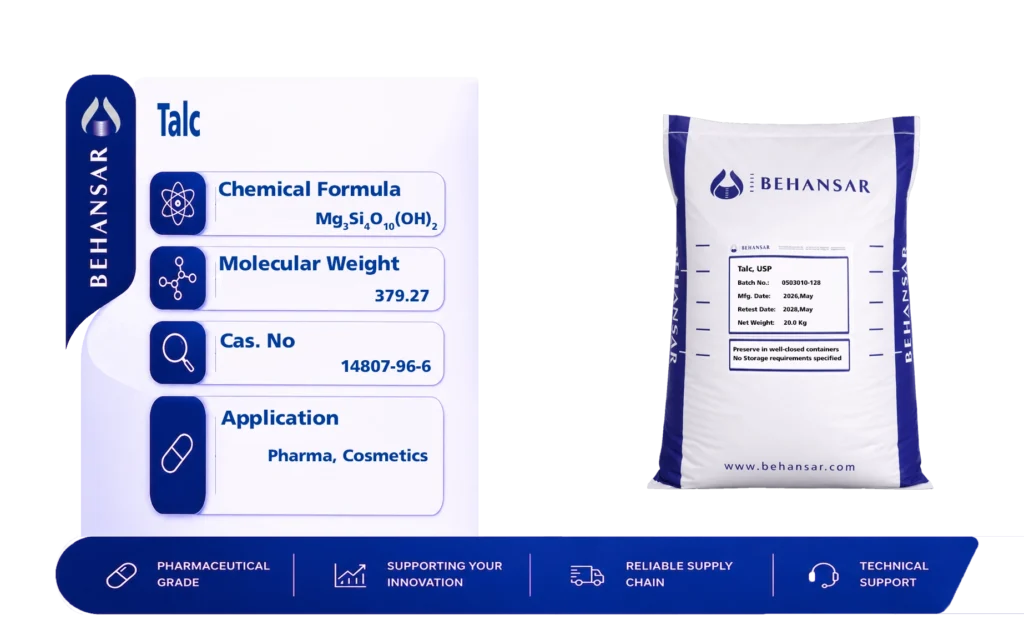
Talc USP is a purified, pharmaceutical-grade hydrated magnesium calcium silicate widely used as a multifunctional pharmaceutical excipient in solid and topical dosage forms. Owing to its excellent lubricating, glidant, anti-caking, and diluent properties, Talc plays a critical role in improving powder flowability, reducing friction during tablet compression, and enhancing manufacturing efficiency.
Pharmaceutical-grade magnesium silicate is manufactured and purified to comply with strict pharmacopeial standards, ensuring high purity, consistent quality, and freedom from asbestos contamination. At Behansar, Talc is supplied under controlled quality systems to meet the demanding requirements of pharmaceutical and cosmetic manufacturers.
Applications and functional roles of Talc USP in pharmaceutical formulations
Pharmaceutical Talcum functions as a versatile excipient in a wide variety of formulations.
Its primary functional categories include:
- Tablet lubricant
- Capsule lubricant
- Glidant
- Anti-caking agent in tablet coating systems
- Diluent
- Adsorbent
- Dissolution retardant for modified-release formulations
These multifunctional properties make Talc one of the most widely recognized mineral excipients used in pharmaceutical manufacturing.
Advantages of Pharmaceutical Grade Talc
The unique lamellar crystal structure and excellent lubricating characteristics of Talc provide several formulation advantages, including:
- Excellent powder flow improvement
- Reduced friction during tablet compression
- Improved tablet ejection from dies
- Enhanced manufacturing efficiency
- Excellent anti-caking performance
- Suitable for controlled-release formulations
- High chemical stability
- Low moisture content
- Good compressibility support
- Superior particle lubrication
- Cost-effective multifunctional excipient
- Pharmacopeial compliance for pharmaceutical applications
Because of these characteristics, Talc is frequently selected for formulations requiring reliable processing performance and consistent product quality.
Physical and Chemical Properties
Pharmaceutical Talc is a naturally occurring purified hydrated magnesium silicate, approximating the chemical formula:
Mg6(Si2O5)4(OH)4
It may contain small controlled amounts of naturally occurring aluminum silicate and iron compounds depending on the source and purification process.
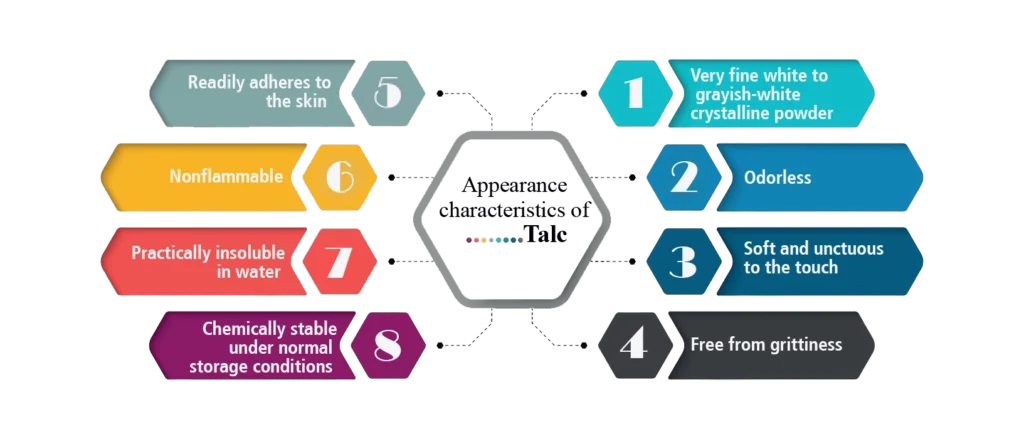
Its lamellar particle morphology provides excellent lubrication and gliding performance during pharmaceutical manufacturing.
Applications of Talc
Thanks to its unique mineral structure, excellent lubricating properties, chemical stability, and outstanding flow-enhancing characteristics, Talc is widely used across the pharmaceutical and cosmetic & personal care sectors.
Pharmaceutical Applications
Pharmaceutical Grade Talc is extensively used as a multifunctional excipient in solid dosage forms and topical pharmaceutical products.
Typical pharmaceutical applications include:
- Tablet lubricant
- Tablet glidant
- Tablet and capsule diluent
- Tablet coating systems
- Hard capsule formulations
- Powder blends
- Direct compression formulations
- Wet and dry granulation processes
- Controlled-release and modified-release tablets
- Extended-release pellet coating systems
- Pharmaceutical adsorbent
- Dry powder formulations
- Dusting powders
- Medicated topical powders
- Dermatological preparations
Due to its excellent lubrication and flow properties, Talc helps improve manufacturing efficiency while ensuring consistent tablet compression and capsule filling performance.
Cosmetic and Personal Care Applications
High-purity Talc is widely used in cosmetic and personal care formulations because of its exceptional softness, moisture-absorbing capacity, smooth texture, and excellent skin feel.
Common cosmetic applications include:
- Slip and Spreadability Enhancer
- Sensory Modifier
- Moisture & Sebum Absorbent in products such as body powder, baby powder, and antiperspirant powder
- Mattifying Agent
- Powder Processing Aid
- Mineral Filler
- Compaction Aid
- Opacifying Agent
- Texture and Rheology Modifier
In cosmetic products, Talc enhances spreadability, improves product texture, absorbs excess moisture, reduces friction, and provides a smooth, silky finish on the skin.
Compatibility
Talc is generally compatible with a wide range of pharmaceutical excipients.
However, it may exhibit incompatibility with:
- Quaternary ammonium compounds
Compatibility studies should always be performed during formulation development to ensure optimal product stability and performance.
Storage Conditions
To maintain product quality and performance, Talc should be stored under appropriate conditions:
- Preserve in tightly closed containers.
- Store in a cool, dry, and well-ventilated place.
- Avoid contamination during handling.
Under recommended storage conditions, Talc remains chemically stable for extended periods.
Method of Manufacture
Pharmaceutical Talc is obtained from naturally occurring mineral deposits found in various regions around the world.
Following mining, the material undergoes carefully controlled purification processes that may include:
- Crushing and milling
- Flotation to remove mineral impurities
- Elimination of asbestos-containing particles
- Acid treatment
- Washing
- Drying
- Fine micronization
- Particle size classification
- Pharmaceutical quality control testing
Modern pharmaceutical manufacturing emphasizes stringent purification procedures to ensure asbestos-free Talc suitable for pharmaceutical applications.
Safety and Regulatory Status
Pharmaceutical Grade purified Talc has a long history of use as a pharmaceutical excipient and is generally regarded as safe when manufactured according to pharmacopeial requirements.
High-quality pharmaceutical Talc is:
- Manufactured to comply with USP, BP, Ph. Eur., and JP standards
- Included in the FDA Inactive Ingredients Database for multiple dosage forms
- Accepted for use in pharmaceutical products in numerous regulated markets
- Approved for use in various non-parenteral pharmaceutical formulations
- Accepted as a food additive in Europe for specific applications
To ensure patient safety, pharmaceutical Talc should always be sourced from deposits verified to be free of asbestos contamination and subjected to rigorous quality testing.
Why Choose Behansar Pharmaceutical Talc?
Behansar supplies high-quality Talc USP Grade manufactured with a strong commitment to quality, consistency, and regulatory compliance.
Our Talc is carefully selected and processed to provide reliable performance across a broad range of pharmaceutical manufacturing applications.
Advantages of Behansar Talc
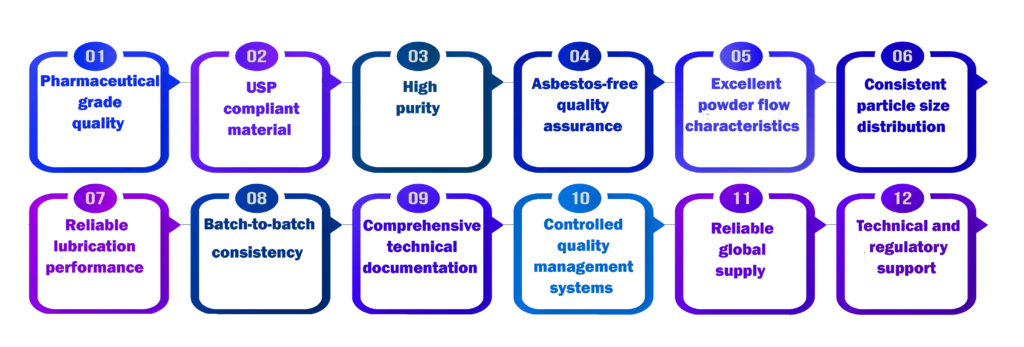
Behansar – Your Trusted Partner for Pharmaceutical Talc
With extensive expertise in pharmaceutical excipients and advanced quality management systems, Behansar provides Talc USP Grade that meets the expectations of pharmaceutical and cosmetic manufacturers.
Whether used in tablet manufacturing, capsule production, controlled-release formulations, film coating systems, or topical pharmaceutical products, Behansar Talc USP delivers the purity, consistency, and reliable performance required by today’s pharmaceutical manufacturers.
Frequently Asked Questions (FAQs)
Can Talc USP be used in pharmaceutical film coating formulations for tablets?
Yes. Talc USP is widely used in pharmaceutical film coating formulations for tablets as an anti-caking agent. It helps prevent tablets from sticking during the coating process, improves coating uniformity, enhances process efficiency, and contributes to a smooth, high-quality tablet finish.
What is the recommended concentration range of Talc USP when used as a glidant and lubricant in tablet formulations?
Talc USP is typically used at concentrations ranging from 1% to 10% w/w when incorporated into tablet formulations as a glidant and lubricant.
What is the role of Talc USP in controlled-release formulations?
Talc USP can be used as a dissolution retardant in controlled-release pharmaceutical formulations. It helps slow the penetration of dissolution media and may contribute to controlling the release rate of the active pharmaceutical ingredient (API).
Which pharmaceutical compounds are known to be incompatible with Talc USP?
Talc USP is generally compatible with most pharmaceutical excipients. However, it may be incompatible with quaternary ammonium compounds.
What personal protective equipment (PPE) should be used when handling Talc USP, and why?
When handling Talc USP, appropriate personal protective equipment (PPE) should be used to minimize exposure to airborne dust. Safety glasses or chemical splash goggles are recommended to protect the eyes from irritation, while suitable protective clothing and gloves help reduce skin contact. In environments where dust generation is possible, a dust mask or approved particulate respirator should also be considered. Although pharmaceutical-grade Talc USP is generally regarded as safe when handled properly, prolonged or excessive exposure to airborne particles may cause mechanical irritation to the eyes and respiratory tract. Following Good Manufacturing Practices (GMP) and workplace safety procedures is recommended during handling.
References: Handbook of Pharmaceutical Excipients, 9th ed
Product Information
Product Number | Product Name | Pharmacopoeia | Product Features | Storage Conditions |
151300037 | Talc | USP | Very fine white to grayish-white crystalline powder, Odorless, Nonflammable, Partically insoluble in water | Preserve in tightly closed containers Stor in cool, dry and well-ventilated place avoid contamination during handling |