
Sodium Carbonate USP by Behansar Co.
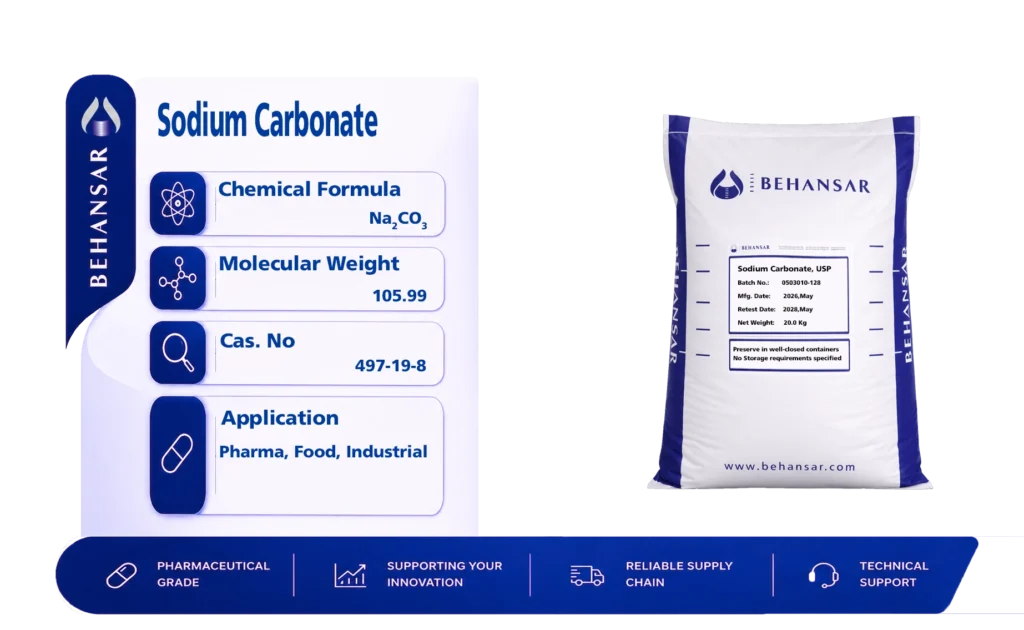
Product Introduction
Sodium Carbonate USP is a high-purity pharmhttps://www.behansar.com/en/applications/medical/aceutical-grade inorganic compound widely used as an alkalizing agent, buffering agent, pH adjuster, and processing aid in pharmaceutical manufacturing. Owing to its excellent alkalinity, high water solubility, and well-established safety profile, Sodium Carbonate plays an important role in controlling formulation pH, improving chemical stability, and supporting various pharmaceutical manufacturing processes.
Pharmaceutical-grade Sodium Carbonate is manufactured under strict quality control systems to comply with recognized pharmacopeial standards, ensuring consistent purity, low impurity levels, and reliable performance in pharmaceutical applications.
At Behansar, Sodium Carbonate USP is supplied under controlled quality management systems to meet the demanding requirements of pharmaceutical manufacturers, nutraceutical producers, laboratory reagent suppliers, and specialty chemical industries.
Functional Category
Pharmaceutical Sodium Carbonate serves as a multifunctional pharmaceutical ingredient in numerous formulations.
Its primary functional categories include:
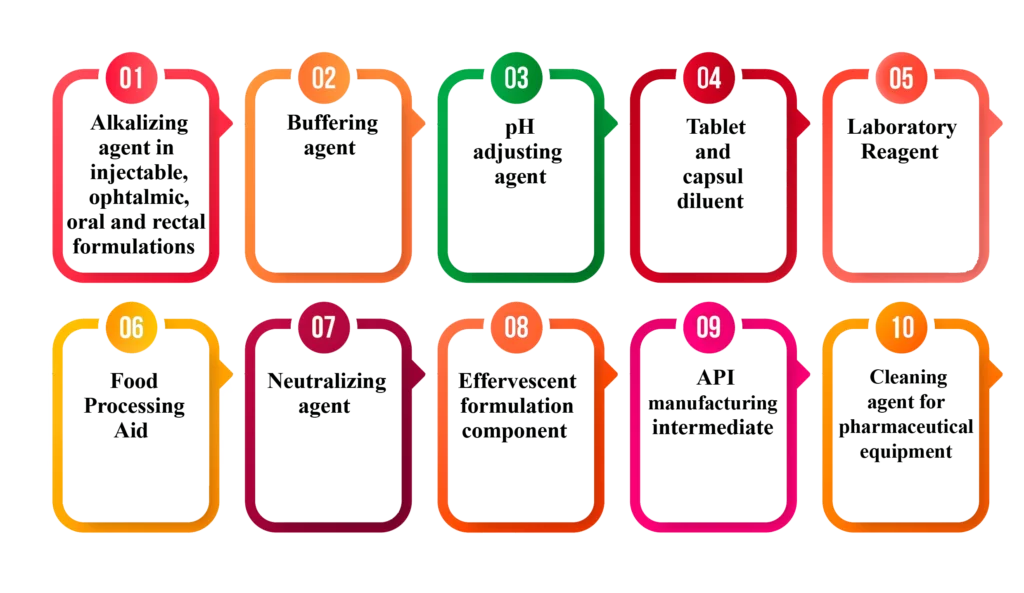
These multifunctional properties make Sodium Carbonate one of the most widely used inorganic pharmaceutical processing chemicals.
Advantages of Pharmaceutical Grade Sodium Carbonate
The excellent alkalinity, high aqueous solubility, and chemical stability of Sodium Carbonate provide several formulation and manufacturing advantages, including:
- Rapid dissolution in water
- Excellent pH adjustment capability
- High buffering capacity
- Reliable neutralization of acidic solutions
- Consistent pharmaceutical quality
- High chemical purity
- Excellent process reproducibility
- Cost-effective pharmaceutical ingredient
- Low organic impurity profile
- Stable during normal storage
- Easy handling during manufacturing
- Pharmacopeial compliance for pharmaceutical applications
Because of these characteristics, Sodium Carbonate is frequently selected whenever precise pH control, buffering performance, or alkalinity adjustment is required during pharmaceutical production.
Physical and Chemical Properties
Sodium Carbonate is an inorganic sodium salt of carbonic acid with the molecular formula:
Na₂CO₃
Pharmaceutical-grade Sodium Carbonate typically appears as:
- White crystalline powder or granules
- Odorless
- Hygroscopic
- Strongly alkaline in aqueous solution
- Freely soluble in water
- Practically insoluble in ethanol
- Stable under recommended storage conditions
- Nonflammable
A 1% aqueous solution typically exhibits a pH between 11.0 and 11.5, making Sodium Carbonate an effective alkalizing and buffering agent in pharmaceutical formulations.
Applications of Sodium Carbonate
Thanks to its strong alkalinity, high water solubility, excellent buffering capacity, and chemical stability, Sodium Carbonate is widely used across the pharmaceutical, food, laboratory, and industrial sectors.
Pharmaceutical Applications
Pharmaceutical Grade Sodium Carbonate is extensively used as a pharmaceutical processing aid and formulation ingredient.

Food and Nutraceutical Applications
Food-grade Sodium Carbonate is widely used as a food additive and processing aid.

Compatibility
Sodium Carbonate is generally compatible with many pharmaceutical excipients and inorganic salts.
However, it may exhibit incompatibility with:
- Strong mineral acids
- Acid-sensitive active pharmaceutical ingredients (APIs)
- Aluminum salts
- Magnesium salts (under certain pH conditions)
- Calcium salts (may form insoluble carbonates)
- Heavy metal salts
- Moisture-sensitive formulations
Compatibility studies should always be performed during formulation development to ensure optimal stability, efficacy, and product performance.
Storage Conditions
To maintain product quality and performance, Sodium Carbonate should be stored under appropriate conditions:
- Preserve in tightly closed containers.
- Store in a cool, dry, and well-ventilated place.
- Protect from moisture and humidity.
- Avoid prolonged exposure to carbon dioxide and acidic vapors.
- Prevent contamination during handling.
Under recommended storage conditions, Sodium Carbonate remains chemically stable for extended periods.
Method of Manufacture
Commercial pharmaceutical-grade Sodium Carbonate is generally produced using highly purified industrial processes.
The most common manufacturing routes include:
- Solvay process (ammonia-soda process)
- Trona ore purification and refining
- Crystallization
- Filtration
- Drying
- Milling
- Particle size classification
- Pharmaceutical quality control testing
Modern pharmaceutical production emphasizes strict impurity control, consistent particle size distribution, and compliance with pharmacopeial specifications to ensure suitability for pharmaceutical applications.
Safety and Regulatory Status
Pharmaceutical Grade Sodium Carbonate has a long history of safe use in pharmaceutical, food, and laboratory applications when manufactured according to recognized pharmacopeial standards.
High-quality Sodium Carbonate is:
- Manufactured to comply with USP, BP, Ph. Eur., and JP specifications (where applicable)
- Recognized as a pharmaceutical excipient
- Widely accepted in pharmaceutical manufacturing worldwide
- Used as an approved food additive (E500(i))
- Included in numerous pharmaceutical processing applications
- Supported by established toxicological and safety data
When handled according to Good Manufacturing Practices (GMP), Sodium Carbonate provides excellent safety, quality, and manufacturing reliability.
Why Choose Behansar Pharmaceutical Sodium Carbonate?
Behansar supplies high-quality Sodium Carbonate USP Grade manufactured with a strong commitment to quality, consistency, and regulatory compliance. Our Sodium Carbonate is carefully selected, processed, and quality-tested to provide reliable performance across a broad range of pharmaceutical, nutraceutical, laboratory, and industrial manufacturing applications
Advantages of Behansar Sodium Carbonate

Behansar – Your Trusted Partner for Pharmaceutical Sodium Carbonate
With extensive expertise in pharmaceutical excipients and advanced quality management systems, Behansar provides Sodium Carbonate USP Grade that meets the expectations of pharmaceutical manufacturers, nutraceutical companies, research laboratories, and specialty chemical producers.
Whether used in pharmaceutical formulation, buffer preparation, pH adjustment, API manufacturing, analytical laboratories, or industrial processing, Behansar Sodium Carbonate USP delivers the purity, consistency, and reliable performance required by today’s pharmaceutical industry.
Frequently Asked Questions (FAQs)
Can Sodium Carbonate USP be used as a pharmaceutical pH-adjusting agent?
Yes. Sodium Carbonate USP is widely used to increase the pH of pharmaceutical formulations and to neutralize acidic solutions during manufacturing and formulation development.
What is the recommended concentration of Sodium Carbonate in pharmaceutical formulations?
The concentration depends entirely on the formulation and desired pH. In buffer systems and pH adjustment applications, Sodium Carbonate is typically used in carefully calculated amounts based on formulation requirements rather than at a fixed concentration.
Is Sodium Carbonate USP suitable for effervescent tablet formulations?
Yes. Sodium Carbonate can be incorporated into certain effervescent systems where controlled carbon dioxide generation and alkalinity are required. However, Sodium Bicarbonate is more commonly employed in conventional effervescent formulations because of its milder alkalinity and more controlled reaction profile.
What is the pH of a Sodium Carbonate solution?
A 1% aqueous solution generally exhibits a pH between 11.0 and 11.5, depending on concentration, temperature, and water quality.
Which pharmaceutical compounds are incompatible with Sodium Carbonate?
Sodium Carbonate is incompatible with strong acids and may react with calcium, magnesium, aluminum, and heavy metal salts to produce insoluble precipitates or undesirable chemical reactions. Compatibility studies are recommended during formulation development.
What personal protective equipment (PPE) should be used when handling Sodium Carbonate USP?
Appropriate PPE should include safety glasses or chemical splash goggles, chemical-resistant gloves, and suitable protective clothing. In areas where dust may become airborne, an approved dust respirator should be considered. Although Sodium Carbonate has relatively low toxicity, prolonged exposure to dust may cause irritation of the eyes, skin, and respiratory tract.
Is Sodium Carbonate USP hygroscopic?
Yes. Sodium Carbonate can absorb moisture from the atmosphere, and prolonged exposure to humid conditions may affect its flowability and handling characteristics. Therefore, moisture protection during storage is recommended.
Can Sodium Carbonate USP be used in buffer preparation?
Yes. Sodium Carbonate is one of the most commonly used alkaline components in carbonate buffer systems and is frequently employed in pharmaceutical, biochemical, and analytical laboratories.
Is Sodium Carbonate USP chemically stable during storage?
Yes. Under recommended storage conditions, Sodium Carbonate remains chemically stable for extended periods. However, prolonged exposure to moisture and atmospheric carbon dioxide may gradually alter its physical characteristics and buffering performance.
- Conduct stability studies whenever Sodium Carbonate is incorporated into moisture-sensitive formulations.
- For pharmaceutical manufacturing, always use USP or equivalent pharmacopeial grade material.
References
- United States Pharmacopeia (USP–NF). Sodium Carbonate Monograph.
- European Pharmacopoeia (Ph. Eur.). Sodium Carbonate.
- British Pharmacopoeia (BP). Sodium Carbonate.
- Handbook of Pharmaceutical Excipients, Pharmaceutical Press, latest edition.
- FDA Inactive Ingredient Database (IID) – Sodium Carbonate.
- PubChem Compound Summary: Sodium Carbonate (CID 10340).
- European Food Safety Authority (EFSA) – Sodium Carbonate (E500(i)).
- Joint FAO/WHO Expert Committee on Food Additives (JECFA) – Sodium Carbonate.
- ICH Q7 – Good Manufacturing Practice Guide for Active Pharmaceutical Ingredients.
- .Rowe RC, Sheskey PJ, Quinn ME. Handbook of Pharmaceutical Excipients. Pharmaceutical Press
Product Information
Product Name | Sodium Carbonate |
Pharmacopoeia | USP |
Garde | Pharmaceutical |
Product Feature | White crystalline powder or granules, Odorless, Hygroscopic, Freely soluble in water, Practically insoluble in ethanol, Nonflammable |
Storage Condition | Preserve in tightly closedcontainers, Store in a cool,dry and well-ventilated place, Protect from moisture and humidity |